
Table of Contents
Watercolour is one of the oldest art mediums, tracing its roots back to Palaeolithic cave paintings and ancient Egyptian papyrus, before evolving significantly following the invention of paper in China.
While it gained traction in Europe during the Middle Ages, the medium truly blossomed during the Renaissance under masters like Albrecht Dürer. It reached a new peak in 18th-century Britain with the growing vogue for painting local landscapes outdoors.
This practice would later become world-renowned as "en Plein-Air" through the 19th-century Barbizon French School, paving the way for Impressionists and Post-Impressionists to "catch" the fleeting impressions of the environment. By observing the sun's movement every two hours, these artists captured the continuous changing of the colour and intensity of light.
A Brief History of the Medium
- Early civilizations used water-based natural pigments for murals and manuscripts. Chinese, Japanese, and Indian art incorporated water-based inks and pigments early on.
- During the Renaissance & Baroque, most artists used watercolours for sketches and nature studies.
- The Golden Age (18th-19th Century) of watercolour arrived in Britain, used for topographical drawings, documentation, and atmospheric landscapes by artists such as J.M.W. Turner, Paul Sandby, and Thomas Girtin.
- In 1766, William Reeves revolutionized the medium by selling dried, portable cakes of paint, making it more accessible, mixing pigments with "gum arabicum" (extracted from Acacia trees in the Middle East) and pushing the popularity of this medium.
- Finally, watercolour societies were established (e.g., in London in 1804), cementing its status as a fine art medium.
It is now widely used for its versatility in creating both soft washes and detailed, vibrant works.
Understanding the Alchemy of the Medium

To master the art, one must understand the science. Watercolour paint consists of 4 principal ingredients:
- Pigment: the source of colour;
- Gum Arabic: acting as a binder to hold the pigment in suspension;
- Additives: such as glycerine, ox gall, honey, and preservatives to alter the viscosity, hiding, durability or colour of the pigment and vehicle mixture;
- Evaporating Water: serving as a solvent used to thin or dilute the paint for application.
While it seems very simple to paint with, watercolour is perhaps the most complicated medium to master. In this medium, the white colour is the paper itself, and the surprises when painting on dry or wet paper are so many that a lot of practice is needed, which implies many failures and frustrations.
Why Always Begins with the Line
As you embark on this journey, remember that colour cannot hide a lack of structure. As my great teacher of this medium, Adrian Hill, said: "It is impossible to reconcile a marked ignorance of drawing with the production of water-colour, where drawing is so essentially a factor of the final success."

In parallel with experience, approach and experiments with colour, we must develop the Art of sketching. We should be drawing anywhere, anything interesting.
I often refer to Bodo W. Jaxtheimer, an academic master whose manual Knaurs Mal- und Zeichen-Buch (1961) begins with the chapter: "In the Beginning was the line." This whole adventure called painting begins with drawing, drawing, and more drawing. And it's not just me saying so: all the Old Masters said and did it.
Navigating the Traps of Style & Tutorials
A word of advice for the modern student: Beware of mannerism, mechanical tricks and the ATTRACTIVE EFFECTS of watercolour medium.
In the digital age, one must also beware of any tutorial on the Internet. Consider the source: most real masters and old teachers have an extensive biography of Art Academy’s studies, Art Prizes & Medals, and decades of teaching at Art Institutions.
Before you decide to learn how to destroy an excellent acrylic brush by cleaning it with acetone, alcohol, or cleaners, explore a little about who tells you these tips, and what is his/her artistic career.
Embracing Your First "Hours of Flight"

For your First steps: Acquire good materials and experiment with them; don't expect to create a masterpiece immediately. This stage is about discovery.
- Make sketches, paint them, explore new brushes and colours, dampen paper and paint, and work on dry paper.
- Observe how the materials behave. What colours and mixtures speak to you? Which ones do you prefer?
- At this stage, zero criticism, just play without expecting results.
The old masters of Chinese calligraphy said that you must come to feel the tip of the brush as if it were your fingertips: a continuation or extension of them. Therefore, lots of practice, many "hours of flight." The results will come, but not immediately, as in any craft.
Moving Forward
In next post, I will explain more about the technical part of watercolour painting but, again, previously is needed the discipline of drawing & sketching.
So, let’s sketch, draw, and paint.


Hi Che Antoinette, thank you for your comments. One of my early painting teachers, Eugenio Mariani, used to say that there were no such things as “technical secrets”—only naive people who believed they had reinvented the wheel and that they alone would use or apply it. If one searches, studies, and investigates, the experience of those who came before us is right there—explained and accessible to everyone, as knowledge is meant to be. In painting, examples include the camera obscura, the “black mirror,” and the Renaissance red glass filter used to check tonal values. In sculpture or ceramics, the list is even longer: which acids etch metal to create patinas or special effects, or how a black slip transforms into a metallic gold finish at a specific temperature. Yet, the most important lesson my teacher imparted was this: “A technical trick or secret is like a large, beautiful apple. You are delighted to hold it, to show it off, and to use it; but you must remember the other side of the coin: that apple has taken hold of your hand, leaving it no longer free to grasp and taste new fruits.” That is why—with the same generosity a tree shows in bearing fruit—we must share knowledge, experiences, and information. Ultimately, one must walk one’s own path, make mistakes, and learn from them; that is how we learn and advance professionally. “Technical secrets” are merely an illusion; we should share not just out of generosity, but to remain open to learning, testing, and experimenting. Rembrandt, Turner, and Michelangelo all “played” and experimented right up to their final works. Have a great day!!
Hello Ricardo,
I found this article very informative and enlightening and in line with my perspective and approach to art mediums and in particular watercolour, which is my medium of choice.
I am an emerging artist and self taught and professionally I am a scientist. Maybe that’s why my approach to art is not necessarily aesthetically or emotionally driven, and my initial approach is more about the tools: the paper, the brushes, the paints, pigments and exploring how each behave on their own with water and also together. This may be why I gravitated to this post.
I am a fan of the FUUMUUI products and I will be exploring the paints and papers over the coming months. Hopefully I will be able to share some of my observations with you here and I do look forward to your continued posting.
Kindest Regards
Cher-Antoinette
Barbadian Artist
Hi Jan,
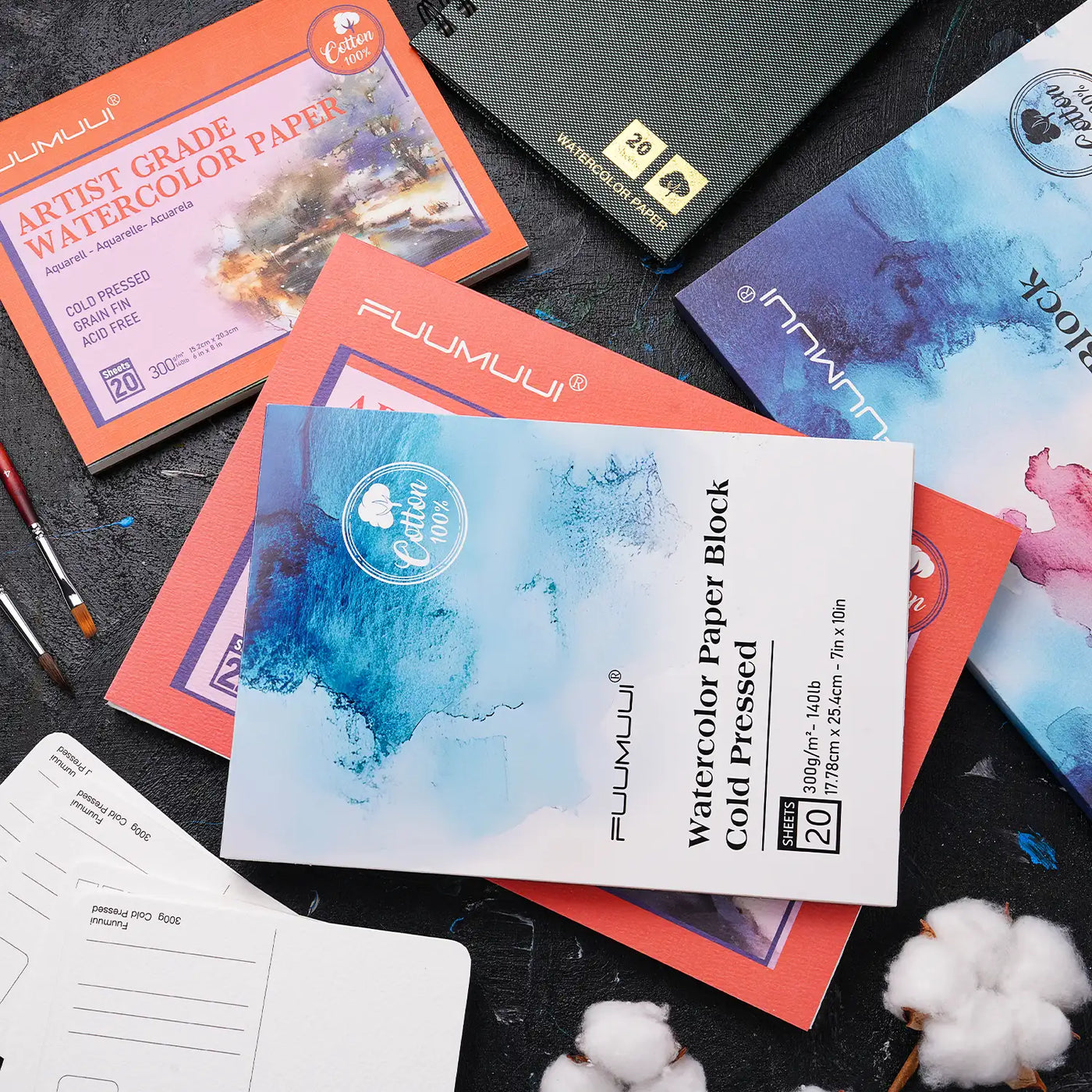
It’s excelent to improve any idea & and to push the materials to the limits of our curiosity, but we must keep in mind that there will be failures or unpleasant surprises when a material is asked to do things it wasn’t designed for. Nothing serious, as it’s all a learning process, but some basic information regarding watercolor and paper: as its name indicates, this medium is based on water, sometimes a lot of water (washes by wetting the paper), and therefore the best paper is the thickest (240 to 300 grams). Even with the thickest paper, it’s best to adhere it to a board with watercolor tape to prevent warping when the paper is saturated with water. Then, when it dries, it will be smooth if it’s well adhered. Very thin papers, like rice paper, were used with water-based inks, especially in the East, but with a roller, not with abundant water, since their absorption capacity is small. In traditional Chinese, Japanese, and Korean calligraphy (sumi-e), ink is also prepared on the spot by rubbing a stick of black organic pigment on a stone container and adding distilled water with a teaspoon about one-fifth the size of a sugar spoon. In traditional batik—as in fabric dyeing—strong pigment colors are used so they penetrate the fabric fibers. Nothing beats experience, and sometimes you can discover things that books don’t recommend, like painting on canvas with watercolors, which is absolutely possible. Good luck with your experiments!
Interesting about the history of watercolour. I am presently getting to know and understand how watercolour paints work. I have done several watercolour batik on rice paper. I love doing these. The subject is drawn with waterproof Micron pens of various sizes.. Hot wax is applied to areas where white is wanted and also after each colour. This is also a challenging way to use watercolour paints. In the end the work is totally covered in wax. Then the wax is removed when the painting is placed between layers of newspaper and a hot iron is used. And then the finished painting is revealed………always with some surprises!! Touch ups can be done when the work is dry. I admit this sounds like a lot of work but I find it so exciting!!