






Table of Contents
Key Takeaways
Verdict: Masking fluid (liquid frisket) is the ultimate tool for preserving crisp whites in watercolor. To succeed, apply it thinly to 100% dry paper and remove it only after both the fluid and paint are completely dry.
- Preparation: Never shake the bottle; this creates bubbles that pop and ruin the seal. Gently roll it instead.
- Tools: Do not use your good brushes, as dried fluid ruins hair instantly. Use a silicone applicator or an old brush coated in soap.
- Removal: Use a Rubber Cement Pickup (or clean finger) to gently lift the fluid. Remove within 24 hours to prevent it from bonding permanently to the paper.
Masking fluid is one of the most powerful "secret weapons" in a watercolorist's toolkit. Whether you are capturing the sparkle of sunlight on water, the delicate veins of a leaf, or the whiskers of a cat, this tool allows you to paint freely without worrying about losing your whites.
In this guide, we will explore what art masking fluid is, how to apply it without ruining your brushes (or your paper), and the best techniques for professional results.
What is Masking Fluid?

Masking fluid is a white or coloured fluid applied directly to the paper, especially in watercolour painting. This is a specialised technique for preserving white areas in paintings to maintain the whiteness of the paper as a highlight. It functions similarly to painter's tape but for liquid mediums.
It works on the principle of "resist techniques"—a method used throughout art history to protect specific areas of a surface from dye or paint. Similar to applying invisible or masking tape to the paper, painting the Masking liquid into areas where the white paper is to be protected from accidentally painting over them.
Once dried, this creates an impermeable protective film that prevents pigment penetration. After your painting is finished, the film can be peeled off, revealing pristine white paper.
This method avoids the precision issues and colour contamination caused by stray brush strokes or splashes of colour, which often occur when trying to preserve the white paper without using masking fluid. For those new to the watercolor painting, understanding these basics is crucial
What are The Components of The Masking Fluid?
Understanding the composition helps you handle the medium better:
- Film-forming agent: The core component, typically natural rubber (latex) or synthetic rubber, forms a tough, water-insoluble film after drying, which is crucial for pigment isolation.
- Solvent: usually water or alcohol, which dissolves the film-forming agent and keeps the masking liquid in a flowing state for easy application.
- Excipients: include preservatives (to extend shelf life), colorants (to add colour for easy observation of application range, commonly gray, blue, pink, without affecting the final image), and thickeners (to adjust concentration for different application scenarios).
Note: Some whitening products contain natural latex. Those with latex allergies should use caution and opt for latex-free formulas.
When Should You Use Masking Fluid?

Masking fluid is best used for specific textures and lighting effects:
- Reserve highlights for details: For example, water droplets on petals, highlight dots on eyes, and the lustre of metallic objects. Apply masking fluid in patches to prevent highlights from being painted over. Mastering these value studies and shadows is key to realistic lighting
- Complex line Masking: For intricate and delicate structures like snowflakes, tree branches, hair strands, window grilles, or lace patterns, manual masking is challenging. Use a Masking Fluid to outline the contours, then peel off after colouring.
-
Multi-layer colour protection: It isn't just for white paper! Watercolour painting often requires layering colours. If a light-coloured area has been completed, you can use Masking Fluid to cover it when adding darker colours to prevent colour mixing.
Essential Tools and Preparation

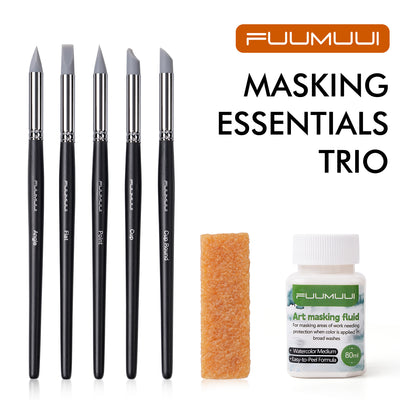
Prepare tools: masking fluid, special eraser, special glue pen.
Pro-Tip: We do not recommend using a brush, as a thin film may remain even when cleaned promptly.
If the masking solution is too thick, add a small amount of water to dilute it (do not add too much, as it may affect the film-forming effect).
How to Use Masking Fluid Correctly
Step 0: Application techniques
- Apply in Thin coats is recommended: The masking liquid doesn't require thick application. A thin and even layer forms an effective protective film. If applied thickly, it increases the risk of problems when peeling/removing the Masking fluid and may cause paper wrinkling or surface damage.
- Precise application: Dip the tool with an appropriate amount of masking liquid, and apply it quickly and accurately to the area requiring masking, avoiding repeated application (which may cause the film layer to crack).
If you have not used masking fluid before, practice on a piece of scrap paper before using it on a new painting.
-
Outline the Area: If you use a light-coloured mask (e.g., white), lightly outline the area with a pencil 2h in advance to avoid missing or exceeding the area.
Step 1: Preparation (Don't Shake It!)

Never shake the bottle. Shaking creates air bubbles. If you apply bubbly fluid to paper, the bubbles will pop when drying, leaving tiny pinholes where paint can seep through. Instead, gently roll the bottle on the table to mix the sediment.
Step 2: Drying and Colouring
Never apply masking fluid to damp paper. If the paper is cool to the touch, it is still wet. Applying fluid to damp paper will lock in moisture and likely tear the surface when you try to remove it later.
Step3: Removing Masking Fluid Safely

Timing is key: After painting, wait until the pigment is fully dry (otherwise, peeling may remove the wet colour/paint), but avoid leaving it for too long (exceeding 24 hours may cause the film to stick to the paper).
To remove Masking Fluid, gently push up the edge with a special eraser, then peel off smoothly. For small areas, you can use a toothpick or tweezers to assist, but be careful not to scratch the paper.
Removing stubborn dried Masking Fluid: If a small amount of the occlusive solution remains, gently wipe it off with a damp cotton swab dipped in a small amount of water (do not rub vigorously). Taking care not to lift any nearby paint!
4 Common Mistakes in Applying Masking Fluid
- Tearing the Paper: Masking fluid can easily damage the surface of watercolour paper. If you apply it to light areas or thinner paper, gently wipe it off to avoid scratching the colours or damaging the paper.
- Applying color before it is dry: Ensure the masking fluid has completely dried before you apply paint. Some artists start painting before the fluid has dried, which could ruin the entire artwork. Remember to keep your brushes away from wet masking fluid, to avoid potential damage.
- Ruining Brushes: Remember, masking fluid for watercolor dries into a solid rubber. Once it cures on a brush, that brush is gone.
-
Using Heat: Do not use a hairdryer on high heat to dry the masking fluid itself. This can "cook" the latex into the paper fibers.
Tips for Selecting and Storage Masking Fluid
Product recommendation
Beginners may choose Fuumuui Masking Fluid (80ml). We will introduce a bundled kit for greater convenience.
Can the Masking Fluid Go Bad?
Yes, here are the storage methods:
- Sealed storage: After use, tighten the bottle cap to prevent solvent evaporation, which may cause the white liquid to thicken or form lumps.
- Cool and dry: Store in a cool and dry place, away from direct sunlight (high temperatures accelerate the deterioration of ingredients);
-
Freeze prevention: Low temperatures may cause latex to solidify and become unusable. Keep warm during winter.
Ready to try this technique? Start with the Fuumuui Masking Fluid, designed for seamless application and easy removal, and watch your watercolor paintings reach a new level of detail and contrast.


Thank you for this article. I found it quite helpful.